Hi !
I am designing a new robot cell and I need to know the maximum forces and torques that the robot applies to the base.
Could anyone help me, that where can I find these datas?
Hi !
I am designing a new robot cell and I need to know the maximum forces and torques that the robot applies to the base.
Could anyone help me, that where can I find these datas?
Didn't find what you were looking for?
New post


Hi Erturo!
You can calculate the maximum forces and torques that the robot applies to the base as follows.
Known Values:
TM = max torque by robot's base joint [Nm]
mPL = max robot payload [kg]
mR = mass of robot [kg]
R = robot reach [m]
g = gravity, 9.81 [m/s2]
Unknown Values:
TB = robot base plate reaction torque [Nm]
Fz = robot base plate reaction force [N]
3. Calculate the forces which are acting on the robot.
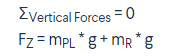
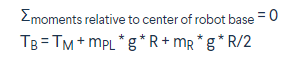
4. Calculate the reaction forces on the base.
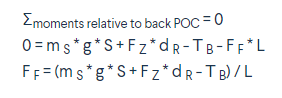
You can get detailed help from the link given below.
https://www.vention.io/blogs/robot-base-how-to-calculate-forces-at-base-101
If you feel any difficulty, feel free to ask

Hi Chang!
Thank you, I will do the calculations and also check the link.

Hello everyone!
I'm also working on something similar.
What are your suggestions / opinions about the material of the robot base. I mean eg. welded steel structure vs made of aluminum profile.
What are the pros and cons of each?
Hi Zachary!
I have experience both with welded steel and aluminium profiles.
The first step to make a decision, depends on the type of the robot. For example: a collaborative robot is "slow", there are low forces and torques but a SCARA applies high dynamic torques ( comes from high acceleration ). Another aspect is the vibration, which is not so good for the aluminum profile's screwed joints, these could loosen .
A welded steel structure is robust, reliable and it has the ability to sink the vibrations. And also it has "weight" - it could be important for example against falling.
But, a big pro to aluminum frame is that it is easy to assemble and easy to modify. The welded structrure is fix and you need a metal work workshop for create or modify.
These are just some point of views, I think we can discuss more about this.

Hello!
I agree with Arturo.
Another pro to welded steel structure is easy FEA. The aluminum profiles have complex sections ( of course, it gives strength to the profile ) which sometimes causes difficulties to FEA.
Hi.
Thanks for the answers!
Can you please help me related to FEA? I think I can do a static analysis with the maximum forces and torques. What is the acceptable displacement?
Thank you in advance.
Hi Zachary!
As I wrote before I have issues with analysing aluminum profile structures. I use Solid Edge software but probably other CAD softwares could handle it easier .
I couldn't find any suggestion on the web related to acceptable displacement but when I design a robot base I always want to reach 0.1 mm maximum displacement. This is my own "rule", and my experience is that this is enough.

Hi Everyone!
I have a question related to this topic: how can I position a 6 axis Fanuc on the base without teaching the points again.
Hi Ayan!
Are you in design phase or you have to change a robot on an existing cell?
Anyway, every robot has positioning features like two surfaces or dowel pin holes. The robot base designer must pay attention to the robot positioning.
Hi Arturo!
Sorry if my question wasn't exact.
I have to change a robot on an existing cell and the robot isn't positioned. Just screwed down.
The robot has many workpoints and I want to avoid teaching them again.
Do you have suggestions for retrofitting positioning jig?
Hi Ayan!
Now I understand your problem.
You can use a positioner like this one on the picture. This positioner part must be installed before changing the robot. Just create the 4 srcewed holes, force the part to the robot reference surfaces and screw it down. Afterwards the robot can be moved because this simple part remains in position.
Hope this help for you.
Hi Arturo!
You are great. Now I start to design the positioner. You saved me a lot of time.
Thanks a lot. After the robot change I will give a feedback about how it works.
Hi Ayan!
Your welcome. Just one more advice : pay attention not to paint the reference surface of the positioner.
Hi!
I wolud like to thanks again. Today we changed the robot with the help of the positioner and it works perfectly.
Please sign in to leave a comment.
Comments
14 comments